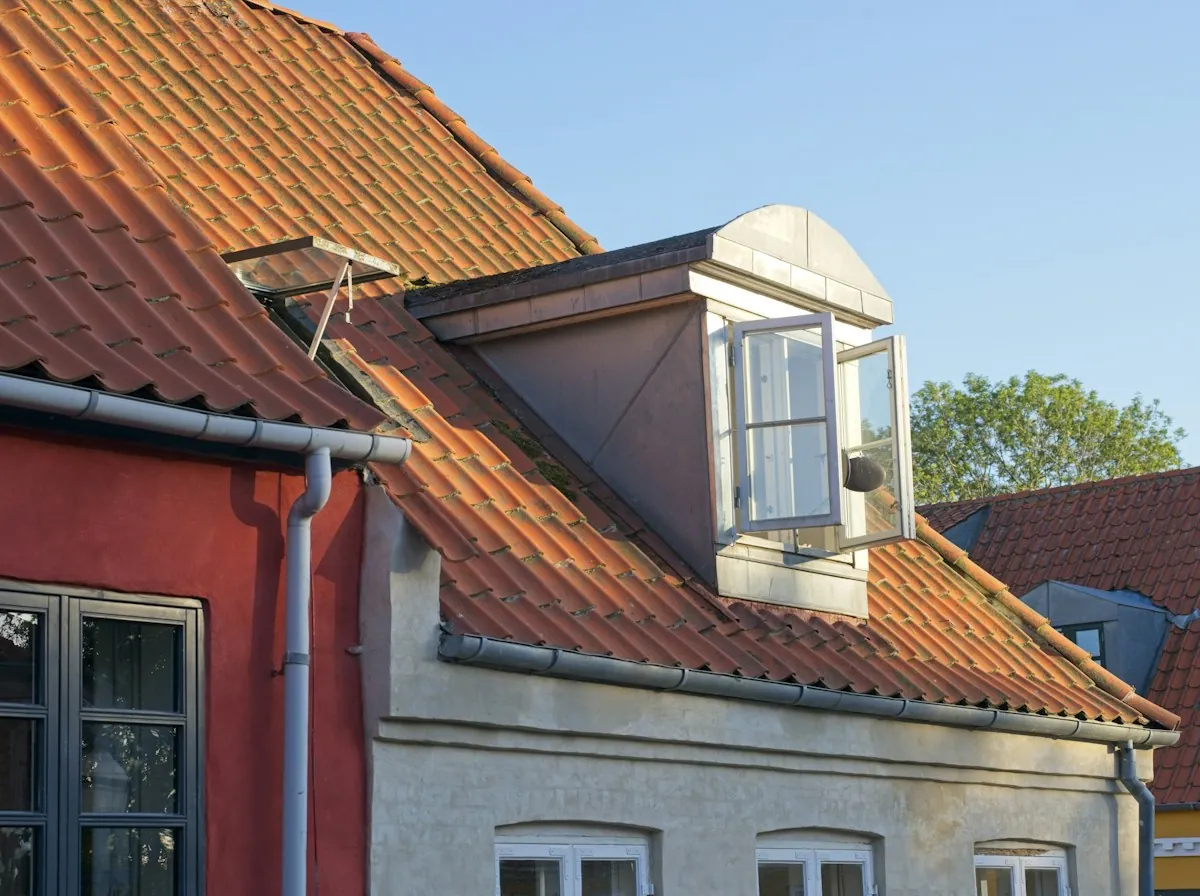
Partial Roof Replacement in the Media District from $350. Sometimes one slope is the right job. Sometimes it is the expensive way to do half a job. Free inspection and a written quote.
On a studio-support building, partial usually means working in sections around plant that cannot be shut down. That is a legitimate reason to phase a roof, but it has to be phased with the cumulative area tracked, because the one-year clock on the 50% rule does not reset because the work was done in stages.
The honest answer is that it depends on where the 50% line falls. Replace more than half the roof area in a one-year period and the whole roof has to comply with current code, which can mean the parts you were not planning to touch. Stay under it and you are doing a genuine repair to one section. That is a code question with a real cost attached, and it is the first thing worth establishing.


A partial sits between a repair, which is $350 to $1,500 here, and a full replacement at $10,000 to $25,000. What decides whether it is good value is not the section price -- it is whether you will be back for the rest inside two years and paying a second mobilization to get it. Here the logistics are a line item rather than an afterthought. Controlled parking, managed loading and restricted work hours all cost time, and studio-support buildings carry roof-mounted plant that has to be lifted and re-flashed. A quote silent on all of that will move once work starts.
Mobilization. Permit, set-up, waste and a crew day cost much the same whether you do one slope or four, so two partials can cost more than one replacement.
A separate structure -- a detached garage, an outbuilding, a rear addition on its own roof -- or one slope that has failed years ahead of the others.
Cross more than half the roof area in a one-year period and the whole roof has to comply. That can change the product, not just the price.
Working around a studio district is a scheduling problem before it is a roofing one. Streets have restricted parking, loading is controlled, and noise windows are real. A quote that has not accounted for where the dumpster goes and when the crew can start is a quote that will slip.
Both Warner Bros. and Walt Disney Studios sit inside the Media District, which is why parking and loading here are managed rather than assumed.
Worth knowing before you start ringing round, and worth factoring into anything with a deadline on it.
Roofs here fail quietly through a dry summer -- ultraviolet light and heat working on the covering, granules washing away, laps loosening -- then a Santa Ana lifts whatever was already loose, and the first serious rain finds all of it at once. Every roofer in the east San Fernando Valley takes those calls on the same three nights.
A replacement in the studio quarter is booked around the district rather than around the weather.
For a condominium or apartment board in the Media District, the lift-and-relay question is the single biggest number on the reserve schedule.
The single-family pockets between the studio lots are ordinary shingle work with an extraordinary access problem.
This is the one area where the low-slope work is genuinely commercial: studio-support buildings with roof-mounted plant, curbs, ducts and a lot of penetrations.
A lot of the residential blocks near the studios turn over quickly and carry short-term tenants, which makes resident notice harder than a fixed notice period suggests.
Laid out 1887. Mixed-era streets, often three roofs a lot.
A 1945-50 grid, and a garage roof out the back.
Verdugo slopes. Fire zone at the margins, hard access.
Horse country. Outbuildings, and Griffith Park litter.
Half lots. All junction, no side yard.
Heavy canopy, high tile share, LADBS permits.
Dense. Small apartment blocks and LADBS permits.
What is worth knowing before you book this.
Usually yes, to some degree. New covering next to weathered covering does not match even in the same product and color, because the old one has faded. Where that matters we put the new work on the least visible slope, or use salvaged material from the section coming off.
There is a point where it stops being just a repair. Replace more than half the roof area in any one-year period and the whole roof has to comply with current code, which can change the product as well as the price. That line gets established before the scope is written.
Because most online figures are national. Asphalt shingle is about $8.50 per square foot here against roughly $4 nationally. A quote that matches a national average is usually missing something -- most often the tear-off or the sheathing allowance.
Maybe, but get a second opinion before you sign anything, and never accept a price given at the door. Ask for a CSLB C-39 number and check it on the public register. That takes a minute and it is the single most effective thing you can do.
It depends on the slope. Burbank is Title 24 climate zone 9, and the steep-slope cool-roof requirement applies in zones 10 to 15 -- so a pitched roof here is generally outside it. Low slope is different: that requirement applies in all sixteen zones with no exemption, once more than half the roof area is replaced.
Free inspection, and a written quote against a written scope. Every slope photographed before and after - the set is yours.